
Knocking Down the Statue
CricViz analyst Ben Jones reflects on England's rivalry with Australia's Scott Boland ahead of the first Test in Perth.

In many ways, all the debate about this Ashes series can be reduced to a simple battle. Can England’s unorthodox approach, their ultra-aggressive batting style, overwhelm the Australian bowling attack?
Because when it comes to taking the ball in hand, England appear to have a clear and simple plan. They have a battery of fast bowlers, almost certainly the quickest they have assembled in a Test squad, and they’re going to come at Australia hard. In Jofra Archer and Mark Wood they have bowlers of genuine Test class, backed up by a run of role players, water-carriers supporting those two stars. It’s not big, it’s not clever, and from an analytical point of view, it’s not altogether very interesting.
That cannot be said for England’s batting. We can list off the statistics, about how Stokes’ England are the fastest scoring Test side in history, scoring their runs at 4.5rpo for almost four years now. They try to hit a boundary with 44% of their shots, the highest figure for a team since records of that type have been kept.
To have arrived at this place, from the timid defeatism of the Root-Silverwood era, to this assertive, faltering, cult-infused alphadom of the McCullum-Stokes pairing, is remarkable. As much as some people try to resist the idea, ‘Bazball’ England are a historic outlier in the manner of their run scoring, and that’s come from nowhere.
In many ways, the turnaround in England’s batting fortunes can be best typified by their returns against one man: Scott Boland.

In that ill-fated 2021/22 Ashes, Boland came to define the series. The Victorian debuting on Boxing Day at the MCG, taking 6-7 to all but seal the urn, the folk hero thrust into the limelight - it was the story of the summer. ‘This guy’s our backup quick’, the baying public crowed, ‘and he’s nicking off the Poms for fun’. Build the man a statue.
18 months later, it was a whole different tale. Stokes had replaced Root, intent has replaced stoicism, England’s aggression was unmasked in every sense, and nobody got more of the brunt of it than Boland.
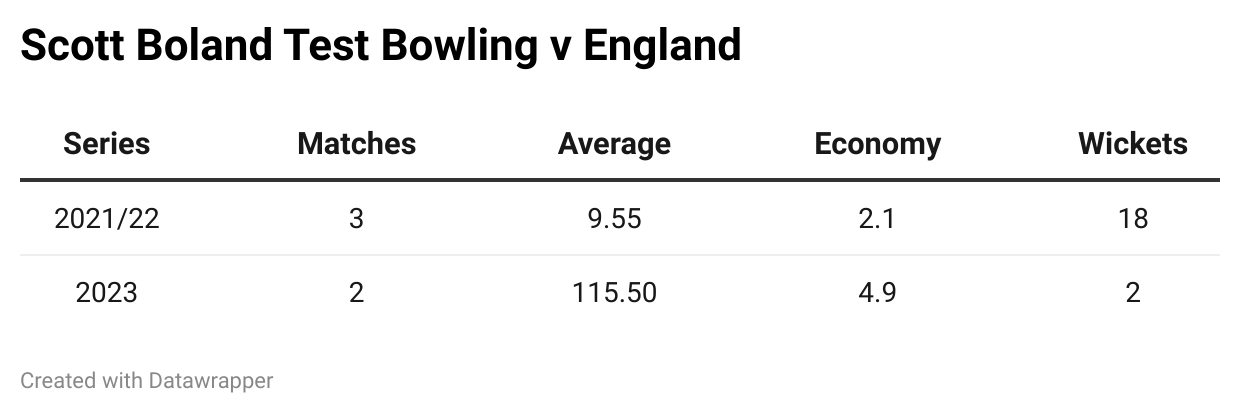
From dismissing six English batters in one breath in 2021, in 2023 Boland got just one England batter out (Zak Crawley, twice). Of the other England batters the slowest strike rate was 84 from Root, and it’s no exaggeration to say they took him apart.
The timbre of the spectacle when he came into the attack was fundamentally different to his teammates. His average in 2023 was the worst overseas Ashes performance by an Australian quick in almost 100 years, going back to Stan McCabe in 1938. England fancied him. A lot.
The contrasting series results here shouldn’t get lost. 2021/22 was a strange contest in many ways, but it was also deeply familiar at its core, with England getting pumped and the captain heading home with his future in peril. 2023 was far from the reverse. A lack of ruthlessness in England’s batting at Lord’s combined with some poor luck at Old Trafford - though can it ever be bad luck for it to rain in Manchester - contriving to keep the Ashes in Australian hands for the fourth series in a row. This wasn’t revenge; it was a stage-setter. For this week.
The tension between two ideas of 2023: an invigorated England who’ve solved the age-old problem of beating the old enemy, thwarted by fortune, or a gambler just needing one more club for a straight flush, clutching at a fallacy for one too many drinks.
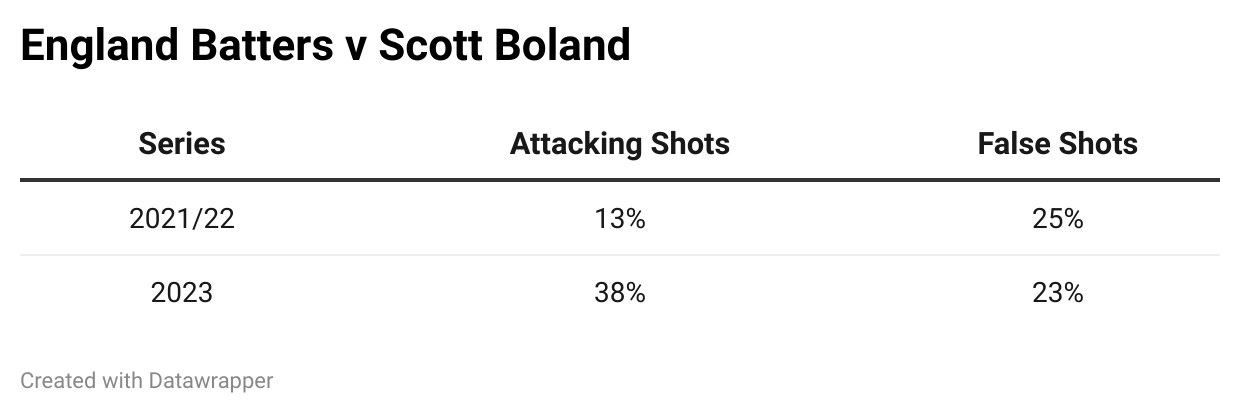
England’s battle with Boland shows this tension perfectly. There is no question that their approach was radically different the second time they faced him, in 2023. That summer, they played 108 attacking shots against Boland, scoring 149 runs, with no dismissals, while in 2021/22 only a handful of England’s dismissals against Boland actually came while attacking. They nicked, they nudged, they left, they blunted, almost of it badly. The turnaround in the way they played him was vindication for the approach in a way few could have predicted.
But it came with risk. In terms of how often they edged or missed the ball across the two series, very little changed. In both series, around one in four of Boland’s deliveries drew some lack of control from the English batters.
Similarly, while his average may have been north of 100, that was clearly an anomaly. His Expected Average based on the balls he bowled was 32, the worst he’s recorded in his Test career but clearly a far cry from the historic failure he managed on the scorecard.
There are a few reasons behind this. One is within Boland’s control, or at least Australia’s. The shift towards the short ball barrage that we saw at Lord’s was an inventive one, but it’s not one which gets the best out of Boland’s skill set. His average length in the 2023 series (7.9m) is the shortest he’s bowled in Test cricket by a mile, and the percentage of balls he had on a good line and length (43%) was his lowest too. That’s Boland’s bread and butter, hitting that handkerchief on a good length in the channel, and he abandoned it. Like it or not, that’s England winning the battle.
Of course, another reason for that huge disparity is simple - he was unlucky. Just as he was exceptionally lucky in 2021/22, when every nervous prod from frazzled English edges went to hand. He, and Australia with him, can choose to believe that this Bazball nonsense will even out over time, and Scotty’s gonna get you eventually. The bloke averages 13 with the ball in home Tests, they’ll say. You aren’t just going to whack him. Boland, surely, just needs to hold his nerve.
That’s why this is such a mouth-watering prospect. With Pat Cummins and Josh Hazlewood both out of the first Test in Perth, more onus than usual falls on Boland’s shoulders. He’s playing alongside a legend of Australian cricket in Mitchell Starc, but also a debutant, an all-rounder who’s only just returned to form, and a spinner who has grown increasingly less influential in recent seasons. There is more scrutiny than usual on his method, and his returns.
So, we should see a clash of ideologies that we’re used to seeing draped in the other’s flag. Boland is best served by the old-school English virtues, accuracy, patience, nibble and guile. England’s batters are playing with a baggy green in their pockets, asserting and looking to dominate from ball one. Both of them are gambling. Both of them are calling the other’s bluff. Whoever’s right will probably win the series.